Mental Health
I have worked as a college lecturer for almost 5 years. Some would expect that teaching is an easy job – you just go into a classroom and teach. However, the fact is: Teaching is not an easy job! I have tried to explain to many people around me that being a lecturer is a 24-hour job. A lecturer’s responsibility is more than just making sure his students pass the course they are taking. A lecturer is also indirectly involved in the mental health of his students. Without his students having good mental health, his class will not be a healthy classroom.
Technology advancement has changed the way students interact with lecturer. Students can reach me at any time, using social networks like Facebook or WhatsApp. Imagine that you are a parent and your daughter whatsapp me at 3 a.m. in the morning, saying that she is very sad and needs someone to talk, or your son telling me he is thinking of committing suicide. What do you (as a parent) expect me to do? What does society expect me to do? What happens if I miss their messages because I am away?
“Sir, I am going through a very painful problem at home. My parents are fighting for a divorce and it is affecting me. They have left the house for almost a month which leaves me behind to handle everything all alone. They do not give me allowance anymore and I am staying alone with no transport to go almost anywhere.”
That was the message that a student texted me not long ago. I could feel her loneliness and her sense of loss. She needed support urgently. In reality, she is not the only student who suffers from life problems. And as a lecturer, I am morally responsible to help students with mental health issues.
Let’s look at some statistics on mental health, divorce and suicides. 40% of Malaysians suffer from mental health issues in their lifetime (Kanyakumari, 2017). Divorce rate in Malaysia is high (Majelan, 2016). According to Associate Professor Dr Mariani Mohd, electronic gadgets and social media are causes of high divorce rates in Malaysia (as cited in “Electronic gadgets”, 2016). Befriender’s KL publicity director, Ardy Ayadali, said that suicide is the second leading cause of death for youths between the ages of 15 and 29 in Malaysia (Pillay, 2017). The suicide rate in Malaysia is about 6 to 8 cases per 100,000 population per year and the highest suicide rate was found among young adults below 30 years old (Pillay, 2017). You can look up more statistics on mental health online. After the recent religious school fire incident, Tan Sri Lee Lam Thye has suggested that we should also focus on the mental health aspect of the incident as it may also be one of the major causes of violence (Lee, 2017). He is spot on, of course!
The question here is: What can we do? I asked my students in class: Who can you go to in Subang Jaya, besides the college counsellor, when you are stressed and need help? The resounding answer was “We don’t know”. Then I asked them another question: How many of you see the college counsellor for your problems? Only a handful of students raised their hands. Surprisingly as it may seems, it is not yet a culture for our students to see a counselor when they have problems. Dr Philip George had said, “The difference is Asians do not talk about their problems. Unlike Caucasians, Asians do not have the words for emotions and that is a huge barrier”.
Based on the above revelations by my students and statistic on mental health issues, it is pertinent that we come up with a project to help youths with mental health issues so that they know there is another platform for them to go to besides their college counsellors when they need someone to talk to. We need an overdue mental health support system for our community.
Human Connection
Human connection seems to have been lost through time. During my highschool years, some students would tell their parents that they had extra co-curricular activities after school so that they can hang out with their friends. Hanging out with friends is one form of social support. This is so different from what is happening today with college students. If a college class starts at 3pm, some students come in late, follow the lesson and, if possible, want to leave early. This leaves them with little time to interact with fellow students face to face. After a semester, some students do not even know who is sitting behind them as little effort is made to get to know each other better, face to face. Hence, the human connection is lost.
Malaysians are very much into technology. Befrienders’ Ardy says there is increasing evidence that social media could contribute to suicide-related behaviour (Pillay, 2017). Last week, The Digital News Report 2017 reported that Malaysians are the world’s largest users of WhatsApp (as cited in “Malaysians are world's”, 2017). The same report also found that Facebook and YouTube are also popular with Malaysians.
We do not deny that the Internet has connected us in more ways than before but it is still important for us to be connected face to face. Health Psychologist McGonigal, during her TED talk presentation, emphasized that when we are experiencing stress, Oxytocin hormone is pumped by the pituitary gland as the stress response (McGonigal, 2016). When oxytocin is released as the stress response, it motivate us to seek support like talk to someone or telling someone how we feel. It is like how we are motivated to see a doctor when we are sick. Thus, it is a natural process that when life is difficult, we want to be surrounded by people who care about us. So when we say that human connection is important, it does not only involve a social emotional factor but also a biological factor. As our society progresses in terms of economy, infrastructure and technology, we must continuously nurture human connection within our community.
Sidewalk Talk Malaysia
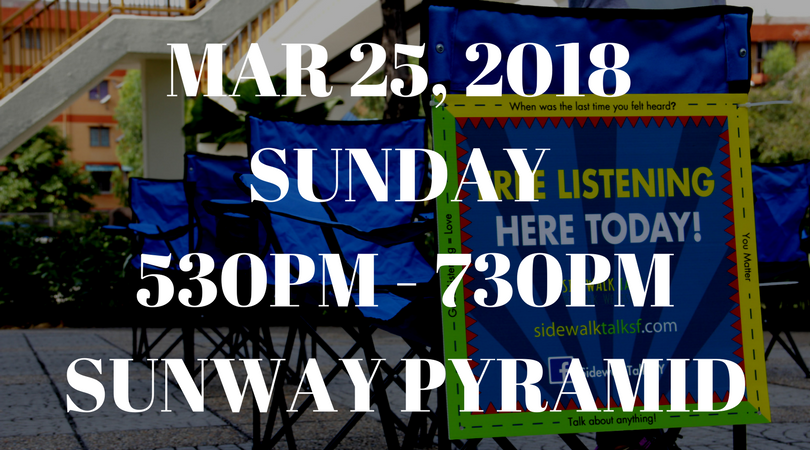
Six months ago, I contacted Ms Traci Ruble, the director of Sidewalk Talk, a community listening movement based in San Francisco. I told her of my intention to start Sidewalk Talk in Malaysia after explaining the mental health situation in Malaysia. She was very supportive of my intention. Together with my students, I have set up a Sidewalk Talk team in Malaysia.
Sidewalk Talk is a non-profit community listening project that aims to nurture human connection by teaching and practicing heart-centered listening in public spaces. As it promotes listening to someone in public spaces, it is relevant if we take into consideration the fact that there are many people who need mental health support and the fact that we will never have enough private counselling rooms for all of them.
Student volunteers undergo a few sessions of empathic listening training and apply the skills they learn during listening sessions with people who have mental health issues. Basically, they listen with the intention to understand these people, to know who they are, to feel what they are feeling and to see things from their perspective.
We at Sidewalk Talk believe empathy is for everyone. We do not provide any advice due to experience constraints and the belief that participants know best how to solve their own problem(s). However, if a participant thinks that he need further help, we will direct him to a professional counsellor or centre.
This project also enables our student volunteers to practise experience learning while preparing them for the workforce. It gives them the opportunity to listen directly to the public as well. It is a practical hands-on experience for all future psychologists. I hope through this project, we can have more psychology graduates joining the mental health profession to cater to the demand for it in our community.
As this is a voluntary project, I would also like to appeal to the public to share information about this project with their friends. Everyone is also welcomed to join our community listening sessions. You talk, we listen.
Mengzhen Lim
Sidewalk Talk Malaysia
Chapter Leader
References
Kanyakumari, D. (2017, April). Depression: 40% of Malaysians will suffer from mental health issues in their lifetime. In The star online. Retrieved from https://goo.gl/Rh4KCL
Lee, L. (2017, September 18). Mental health problems could be the reason . In The star online. Retrieved from https://goo.gl/CCYByn
Majelan, S. (2016, January 12). Six divorce cases every hour among muslim couples. In Malaysiandigest. Retrieved from https://goo.gl/Hy4JsD
Malaysians are world's largest WhatsApp users. (2017, September 12). In Bernama. Retrieved from https://goo.gl/VZwBtn
McGonigal, K. (2016). The upside of stress: why stress is good for you, and how to get good at it. NY, NY: Avery.
Pillay, S. (2017, May 28). Suicide on the rise among Malaysian youth. In New straits times. Retrieved from https://goo.gl/zTXnpU
YB Hannah Yeoh visited our listening site on September 24, 2017.